 Add to Chrome
 Add to Firefox
 Add to Edge
CollectionLoRA: Collecting 50 Effects in 1 LoRA via Multi-Teacher On-Policy Distillation
May 27, 2026
Customized image editing aims to equip pre-trained diffusion models with specific visual effects using limited paired data, typically via Low-Rank Adaptation (LoRA). As the number of desired effects grows, storing and dynamically loading numerous these effect LoRAs significantly increases deployment overhead. Furthermore, current pipelines typically cascade these effect LoRAs with acceleration modules for fast generation, which triggers severe parameter interference and results in concept bleeding and style degradation. We propose CollectionLoRA, a multi-teacher on-policy distillation framework capable of distilling the concepts of up to 50 different effect LoRAs along with few-step generation capabilities into a single LoRA. This fundamentally resolves the feature interference issue and significantly reduces deployment costs. Specifically, the method introduces (i) a Probabilistic Dual-Stream Routing mechanism that enables the model to randomly switch between data sources during training, effectively enhancing its generalization in unseen scenarios; (ii) an Asymmetric Orthogonal Prompting strategy to achieve concept isolation within the prompt space; (iii) a Coarse-to-Fine Distillation Objective to mitigate the distribution gap between the teacher and student models. Extensive evaluations show that CollectionLoRA distills all customized effects and few-step generation into a single LoRA, reducing deployment overhead while achieving concept fidelity comparable to or better than independently trained teacher models. Code: https://github.com/Qwen-Applications/CollectionLoRA

CoAR: Concept Injection into Autoregressive Models for Personalized Text-to-Image Generation
Aug 10, 2025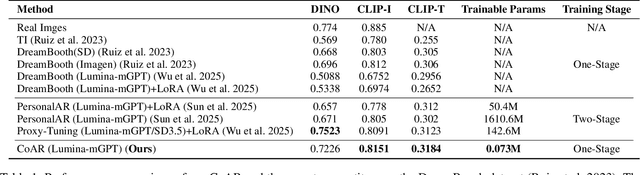
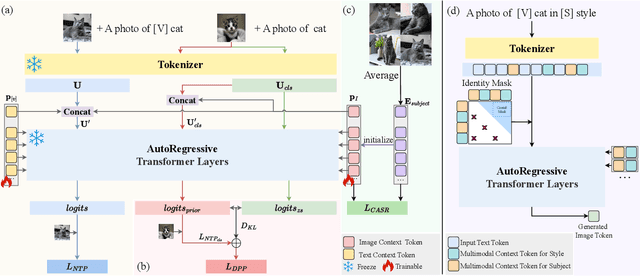
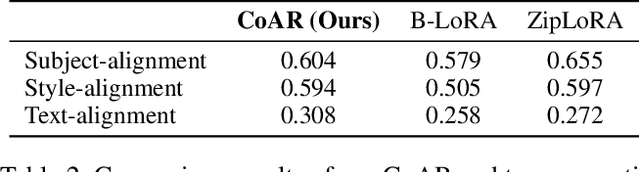
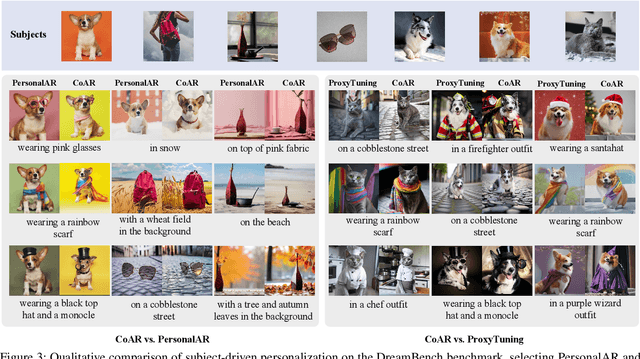
The unified autoregressive (AR) model excels at multimodal understanding and generation, but its potential for customized image generation remains underexplored. Existing customized generation methods rely on full fine-tuning or adapters, making them costly and prone to overfitting or catastrophic forgetting. In this paper, we propose \textbf{CoAR}, a novel framework for injecting subject concepts into the unified AR models while keeping all pre-trained parameters completely frozen. CoAR learns effective, specific subject representations with only a minimal number of parameters using a Layerwise Multimodal Context Learning strategy. To address overfitting and language drift, we further introduce regularization that preserves the pre-trained distribution and anchors context tokens to improve subject fidelity and re-contextualization. Additionally, CoAR supports training-free subject customization in a user-provided style. Experiments demonstrate that CoAR achieves superior performance on both subject-driven personalization and style personalization, while delivering significant gains in computational and memory efficiency. Notably, CoAR tunes less than \textbf{0.05\%} of the parameters while achieving competitive performance compared to recent Proxy-Tuning. Code: https://github.com/KZF-kzf/CoAR
Envisioning Class Entity Reasoning by Large Language Models for Few-shot Learning
Aug 22, 2024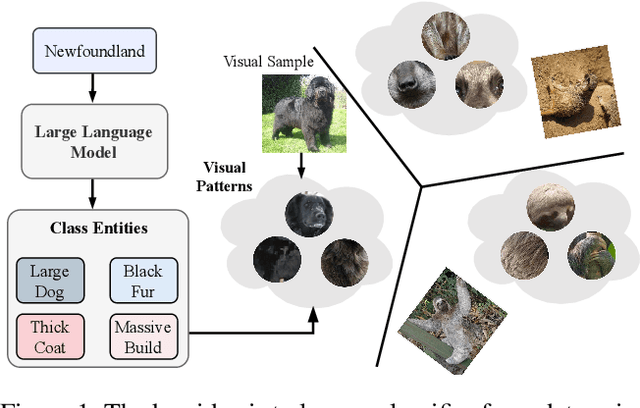
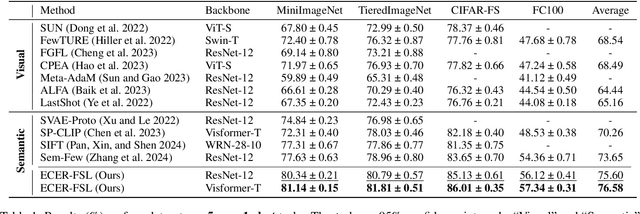
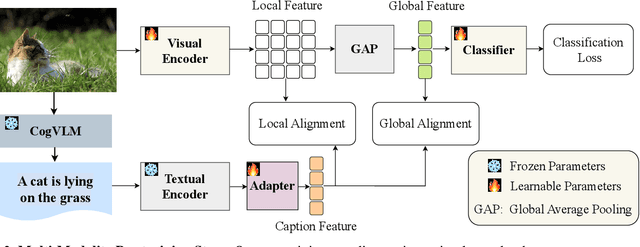
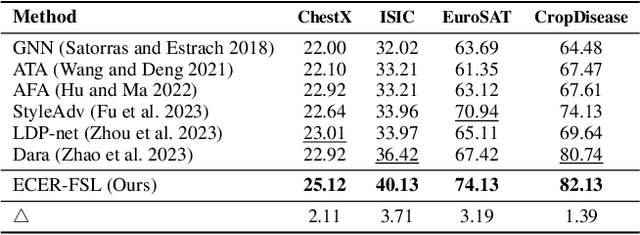
Few-shot learning (FSL) aims to recognize new concepts using a limited number of visual samples. Existing approaches attempt to incorporate semantic information into the limited visual data for category understanding. However, these methods often enrich class-level feature representations with abstract category names, failing to capture the nuanced features essential for effective generalization. To address this issue, we propose a novel framework for FSL, which incorporates both the abstract class semantics and the concrete class entities extracted from Large Language Models (LLMs), to enhance the representation of the class prototypes. Specifically, our framework composes a Semantic-guided Visual Pattern Extraction (SVPE) module and a Prototype-Calibration (PC) module, where the SVPE meticulously extracts semantic-aware visual patterns across diverse scales, while the PC module seamlessly integrates these patterns to refine the visual prototype, enhancing its representativeness. Extensive experiments on four few-shot classification benchmarks and the BSCD-FSL cross-domain benchmarks showcase remarkable advancements over the current state-of-the-art methods. Notably, for the challenging one-shot setting, our approach, utilizing the ResNet-12 backbone, achieves an impressive average improvement of 1.95% over the second-best competitor.